
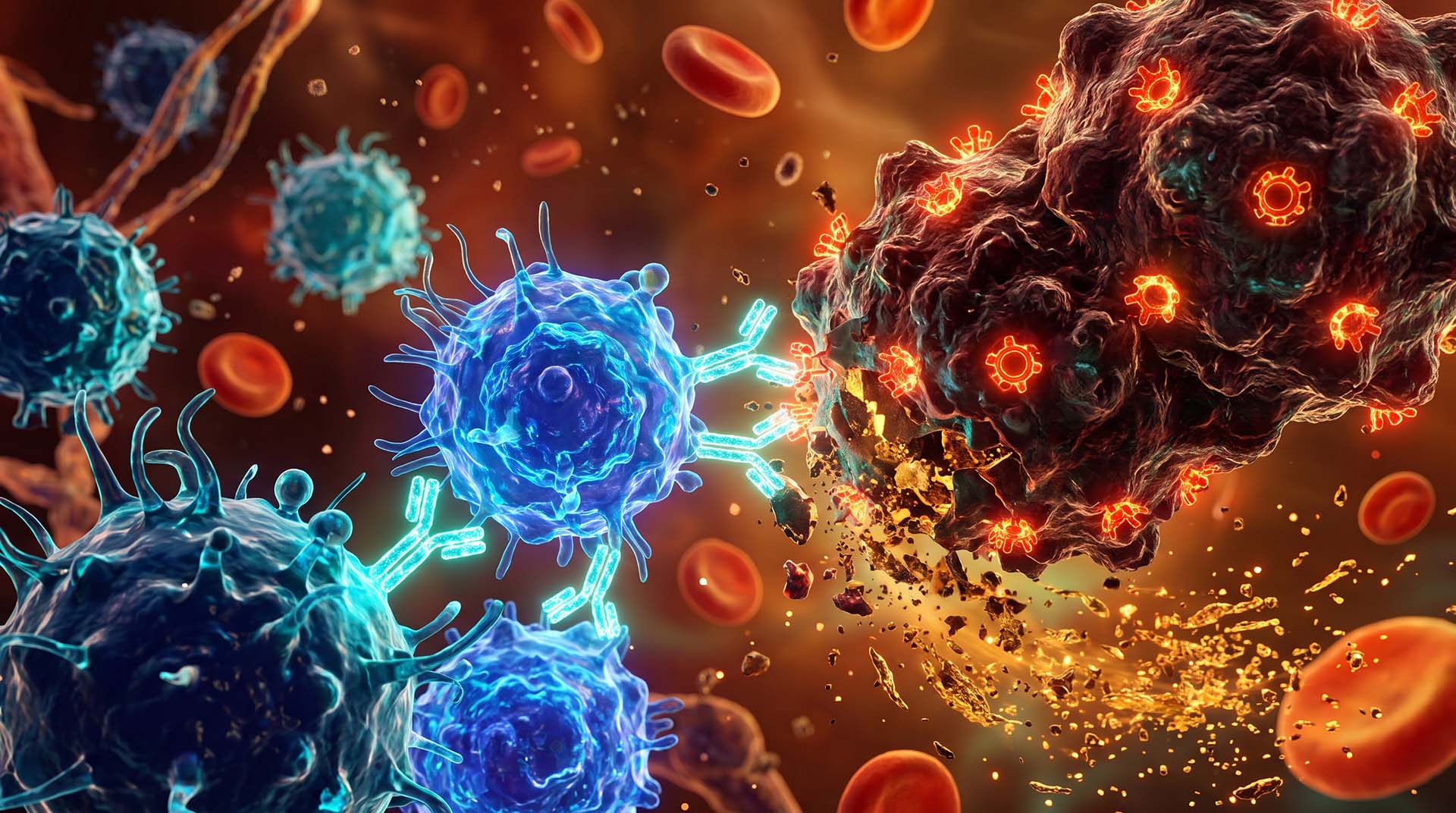
Four statements carry this document.
First, the anti-CD38 therapeutic activity trough (a.k.a. minimum) is the mathematical definition of clinical activity. A trough in a landscape of this kind marks where a therapy works. AQUILA randomized 390 patients with high-risk smoldering myeloma to three years of subcutaneous daratumumab or to active monitoring; median progression-free survival was not reached against 41.5 months, a hazard ratio of 0.49, with overall survival also favoring treatment at a hazard ratio of 0.52.[1] The U.S. FDA approved the indication on November 6, 2025.[2,3]
Second, the mechanism that creates the activity trough also creates a barrier out of it. CD38 is not a myeloma-specific antigen. It is an NAD-glycohydrolase and ADP-ribosyl cyclase carried by resting NK cells, monocytes, activated lymphocytes, dendritic cells, plasma cells and a fraction of marrow precursors,[9,10] and myeloma over-expresses a molecule its normal counterpart already depends on. Daratumumab depletes CD38-positive NK cells by fratricide.[5,6,7] Alloplex manufacturing experience is more restrictive than the published literature: peripheral blood drawn from anti-CD38-exposed patients is the only clearly documented circumstance in which SUPLEXA™ cannot be made at all.[19] That converts a potency caveat into a feasibility exclusion.
Third, the barrier is not merely high but rising. Quadruplet induction has closed the newly diagnosed compartment, PERSEUS-style maintenance is closing the maintenance window,[13] and the November 2025 label is now diffusing into the one compartment that was clean.[17] The population in which the barrier does not yet exist is shrinking as daratumumab use expands. That expansion is fundamentally limited by the toxicity profile, which is deemed inappropriate for patients without severe clinical symptoms — but the limit sits well to the left of where the front stands today.
Fourth, the window of opportunity to utilize a mechanism dependent on CD38+ cells is closed when approaching from the advanced MM direction. Every approved daratumumab schedule converges on administration once every four weeks, continued until disease progression.[4] Recovery of CD38 expression and of the NK compartment requires a treatment-free interval of three to six months,[11] and even beyond twelve months off therapy CD38 expression recovers only partially and not to antibody-naive levels.[12] The longest gap that occurs on any approved schedule is therefore three to six times shorter than the interval required. There is no washout strategy to be designed, because there is no washout to be had.
This document considers observations already recorded in the myeloma landscape analysis but assembles no new data. Every factual claim is drawn from publicly available sources and the internal manufacturing observation is flagged as internal wherever it appears.
The document is intended for three audiences and reads differently for each. For a partner or investor, the argument explains why Alloplex is pursuing precursor disease rather than the late-line settings where the unmet need is most visible, and it does so without requiring the listener to accept any efficacy claim. From a regulatory perspective, it frames the eligibility criterion as a rigid consequence of well understood mechanisms rather than as a mere clinical trial convenience.
In an optimization problem, a local minimum is a point at which every small step in any direction makes the objective worse, but which is nonetheless not the best available solution. An algorithm that only ever moves downhill will enter such a point and stop. It stops not because it has reached its optimal objective but because the local information available to it — the slope immediately underfoot — gives no indication that anything better exists. Escaping the trap of a local minimum requires moving uphill first, which every regulatory procedure is constructed to prohibit.
The features that matter for the analogy are three. The therapeutic activity minimum is real: the depth of the trough is the measure of the drug's therapeutic activity. But the barrier to another, potentially deeper activity minimum cannot be achieved by incremental movement from the existing minimum. Recognizing the reality of clinical practice and regulatory paradigms, the only option left to escape the local minimum is to approach the problem from an entirely new direction; namely in anti-CD38 naïve populations in which the local minimum has not been established.
Most therapeutic uses of the local-minimum metaphor are loose. They mean only that a field has settled on a good-enough answer and stopped looking. The myeloma case is stronger, and the strength comes from a single structural fact: CD38 is the target that produces the depth of response and CD38 is the antigen carried by the effector population a non-engineered NK/NKT-like product like SUPLEXA requires.[5,6] The therapy does not merely occupy the patient's time or exhaust their tolerance for toxicity; it removes the substrate for the alternative therapy. In optimization terms the descent into the local activity minimum raises the barrier to escape.
That is the essence of the figure in Section 4. A conventional landscape figure shows only that a better solution exists somewhere else, which is a claim anyone can make about any field. The distinction made in this figure is that a particular patient cannot emerge from the activity minimum, names the molecule responsible, and provides a mechanistic rationale for this position and an alternative to avoid foreclosing on CD38-dependent mechanisms.
The argument above depends on a fact about CD38 that is often skipped in commercial descriptions of the drug class, and it is worth stating carefully because everything downstream rests on it. CD38 is a normal, widely distributed, functionally important molecule. It is a type II transmembrane glycoprotein that acts both as a receptor and as an ectoenzyme: an NAD-glycohydrolase and ADP-ribosyl cyclase that generates cyclic ADP-ribose and ADP-ribose from NAD, and nicotinic acid adenine dinucleotide phosphate under acidic conditions. All three are second messengers governing calcium mobilization, and through it, proliferation, differentiation, adhesion and signal transduction.[9,10]
The expression list is long. Approximately 80% of resting NK cells and monocytes carry CD38, as do medullary thymocytes, activated T and B lymphocytes, germinal-center lymphoblasts, dendritic cells, plasma cells, erythrocytes, platelets, and a fraction of normal bone marrow precursors; it is also found in gut, brain, prostate, bone and pancreas.[10] Mature resting T and B cells express little or none. The selectivity of anti-CD38 therapy for myeloma is therefore quantitative rather than qualitative — it rests on the very high density of CD38 on the malignant plasma cell relative to everything else, not on the antigen being absent elsewhere.
The inference that follows is the important one. Myeloma has usurped expression of CD38 to gain a survival advantage. If myeloma settled on CD38 as a survival and proliferation factor, then the normal cells that express it may be relying on it for the same reasons. The antigen is a functional dependency shared between both the tumor and the effector compartment.
Two consequences follow directly. An antibody chosen for its therapeutic index against a cell over-expressing CD38 will still deplete every normal population carrying it at lower density — which is precisely what the NK-cell data show.[6,7,8] And there is no biological reason to expect the precursor compartment to be spared, because the precursors express the antigen for the same reason the mature cells do. The Alloplex manufacturing observation bears out this prediction.
One bound on the claim that CD38 is essential for survival should be stated. CD38-null mice are viable, so CD38 is not a survival factor in the absolute sense of an indispensable gene; the dependency is on the calcium and NAD signaling functions it serves within a given lineage and metabolic state. Knockout mice in a clean animal facility do not reflect the human condition which involves exposure to innumerable immune challenges.
Figure 1 renders the entire argument. The vertical axis is residual disease burden, drawn so that deeper is better. The horizontal axis is natural progression of MM by stage, running from MGUS on the left through smoldering myeloma and newly diagnosed disease to relapsed and refractory myeloma on the right. Anti-CD38 therapy entered this landscape from the more advanced patients (right side of the figure), and has been moving toward early-stage disease and is now approved for use in high-risk smoldering myeloma as of November 2025. SUPLEXA cannot follow it in from the right, because to do so is to arrive in a compartment where the starting material no longer exists. It must therefore enter from the left — earlier stage disease such as MGUS, and low to medium risk SMM.
The descent into the anti-CD38 activity minimum is real — daratumumab is a highly active drug for multiple myeloma that is becoming a ubiquitous standard of care. In high-risk smoldering disease the hazard ratio for progression or death is 0.49 and for death is 0.52;[1] in newly diagnosed disease, quadruplet induction has produced the deepest responses the field has recorded.[13] A figure that drew this as a mistake would be dishonest and would be recognized as such by every hematologist who saw it. The point of the figure is the opposite: the patient is in the well precisely because the descent was correct at every step.
The wall in Figure 1 is labeled with a molecule rather than with an abstraction. Published work establishes depletion of circulating CD38-positive NK cells during daratumumab therapy, in a dose-dependent relationship, sustained for as long as the antibody is present.[6,7] The Alloplex manufacturing record goes further and is the more consequential fact: SUPLEXA has not been successfully manufactured from anti-CD38-exposed peripheral blood.[19] A manufacturing failure rather than a potency decrement implies that CD38 is carried by the precursor population on which the ENLYST™ co-incubation acts, so the deficit is not made good over the two weeks of culture — which is exactly what Section 3.3 would predict.
Two consequences follow, and they are stated at greater length in Section 13.1 of the landscape analysis.[17] Anti-CD38 exposure is a feasibility exclusion and belongs in protocol eligibility as such. And collection performed before any anti-CD38 exposure is a prerequisite rather than a convenience.
The barrier height is not fixed. It should be expected to increase with cumulative exposure as the depth of cell depletion proceeds to completion, and the figure does not currently show that because Alloplex does not yet have feasibility stratified by prior lines.
The wall is the load-bearing element of the figure. To its left the CD38-positive compartment is intact and SUPLEXA can be manufactured; to its right it is not and the use of SUPLEXA or other CD38-dependent approaches is foreclosed. The accessible state space depends on the path taken rather than on the current position alone. Once a patient is exposed to daratumumab, a path dependent on CD38 is closed.
CD38-positive SUPLEXA cells are therefore mechanistically restricted to the anti-CD38-naïve population. Two patients with identical disease burden today, one anti-CD38-exposed and one not, do not have the same options tomorrow. That is an unusual property in oncology, where prior therapy usually degrades the probability of benefit rather than eliminating the possibility of an alternative.
| Feature | CD38-naive patient (MGUS, low- and intermediate-risk SMM, high-risk SMM before treatment) | Anti-CD38-exposed patient (treated high-risk SMM, newly diagnosed, all later lines) |
|---|---|---|
| Manufacturing feasibility | Established. SUPLEXA manufactured from peripheral blood without leukapheresis across the Phase 1 program. | Not established. No successful manufacture from anti-CD38-exposed peripheral blood to date. |
| Nature of the constraint | None identified. | Feasibility, not potency. The product cannot be made, rather than made and found weaker. |
| Reversibility in principle | Not applicable. | Three to six months off therapy would be required for CD38 and NK recovery; beyond twelve months, recovery is still only partial. |
| Reversibility in practice | Not applicable. | None. Approved schedules dose every four weeks until progression, so the required interval never occurs. |
| Correct operational response | Collect blood at diagnosis of the precursor state on a validated biomarker. | Treat as ineligible. Do not design a washout, because no washout is available. |
| Direction of travel, 2026 | Shrinking. The November 2025 label is diffusing into high-risk SMM. | Expanding, bounded ultimately by the toxicity profile in asymptomatic patients. |
The most common reply to everything above is that the problem is one of timing rather than of biology: wait for the antibody to clear, then collect. That reply however fails on two counts.
The interval required. A treatment-free interval of three to six months is the published estimate for recovery of CD38 expression and of the NK compartment to baseline.[11] It is not a conservative figure. Independent work on anti-CD38 re-treatment found that patients more than twelve months off a CD38 antibody regained CD38 expression only partially, and not to the level of antibody-naive patients.[12] The kinetics are consistent with the pharmacodynamic data, in which NK-cell counts fall after the first dose, remain suppressed for the duration of exposure, and recover only after treatment ends.[7]
The interval available. Every approved daratumumab regimen escalates the dosing interval to a ceiling of once every four weeks and then holds it there until disease progression or unacceptable toxicity.[4] Four weeks is the longest gap that occurs on any anti-CD38 schedule, in any line, in any combination. The required interval is therefore between three and six times longer than the longest interval the standard of care ever provides.
| Setting | Approved schedule | Longest scheduled gap | Treatment-free interval available |
|---|---|---|---|
| High-risk SMM, monotherapy | Weekly wk 1–8; every 2 wk 9–24; every 4 wk from wk 25 until diagnosis of MM or a maximum of 3 years | 4 weeks | None during therapy. A defined stop at 3 years is the sole structural exception. |
| NDMM, transplant-ineligible (D-Rd) | Weekly wk 1–8; every 2 wk 9–24; every 4 wk from wk 25 until disease progression | 4 weeks | None. Dosing is indefinite. |
| NDMM, transplant-eligible (D-VRd) | Weekly wk 1–6; every 3 wk 7–24; every 4 wk from wk 25 until disease progression | 4 weeks | None. Dosing is indefinite. |
| Relapsed disease (D-Pd, D-Kd) | Weekly wk 1–8; every 2 wk 9–24; every 4 wk from wk 25 until disease progression | 4 weeks | None. Dosing is indefinite. |
| Required for recovery | Three to six months for CD38 and NK reconstitution;[11] only partial recovery beyond twelve months[12] | — | Never reached on any approved schedule. |
The single exception proves the rule. Daratumumab in high-risk smoldering myeloma is the one indication with a defined stop: the label limits monotherapy to a maximum of three years.[4] That is the only place in myeloma where a treatment-free interval is built into the standard of care rather than produced by failure — but it doesn't help. A patient reaching the three-year mark and then waiting a further six months has spent three and a half years in the compartment while the disease continued to evolve and arrives at collection with a precursor compartment that the re-treatment literature suggests will still not have returned to naive baseline.[12] Everywhere else, dosing stops for one of two reasons: disease progression or unacceptable toxicity. Both place the patient in a worse compartment than the one they left.
The argument asserts only that the SUPLEXA option is present before anti-CD38 exposure but absent after it, and that this is a property of a well understood mechanism. The question is purely about sequencing.
If SUPLEXA could be manufactured from anti-CD38-exposed blood after a defined interval, the barrier would have a height, and the argument would become quantitative rather than categorical. But given the current usage pattern of anti-CD38 mAbs, no window large enough to recover the CD38-positive population will ever reappear.[4,11,12] Section 5 sets out the arithmetic.
| The argument asserts | The argument does not assert |
|---|---|
| That anti-CD38 therapy produces a real and substantial improvement in outcome. | Any criticism of the benefit demonstrated by daratumumab, which has been proven through extensive clinical trials. |
| That CD38 is not only expressed by the SUPLEXA effector cells but likely also by the precursor populations in the PBMC from which SUPLEXA cells derive. | That CD38 depletion is harmful in the context of myeloma, aside from the well-documented toxicity profile in the product label. |
| That SUPLEXA cannot be manufactured from anti-CD38-exposed peripheral blood, owing to elimination of the necessary precursor cells. | That CD38-positive cells could never recover if given enough time off anti-CD38 therapy. An interval of roughly three to six months has been documented;[11] standard dosing simply never provides it.[4] |
| That the only population currently available for evaluation of a mechanism relying on a CD38-positive cell population is in the early stages of myeloma, before daratumumab is used. | That daratumumab treatment should be delayed in the myeloma population where it is approved. |
The objections below are the ones that have been raised by experienced clinicians.
| Objection | Response |
|---|---|
| The deeper minimum is hypothetical. You have not shown SUPLEXA reaches it. | Conceded, and the figure labels it as a hypothesis. The argument does not depend on the depth of the second well, only on the existence of the barrier, which is based on mechanism. |
| Advanced disease should be treated first. Precursor intervention with an untested product is inverted. | AQUILA established that an asymptomatic myeloma population may be treated on laboratory risk features, with a label carrying real toxicity warnings.[1,3] A product with no serious adverse events across 220 doses in 35 patients answers the SUPLEXA risk-tolerance question directly. Moreover, the toxicity profile associated with the class of NK and NKT-like cell therapies is generally benign. Taken together, the toxicity profile attributed specifically to SUPLEXA and more broadly to the class of NK-NKT-like cell therapies provides a great deal of safety assurance. |
| Washout will solve this. Wait for the antibody to clear. | The daratumumab pharmacokinetic label describes clearance of circulating antibody. It does not describe reconstitution of a CD38-positive precursor compartment, and the two are not the same question. Data indicate three to six months are required for the CD38-positive population to recover,[11] and standard dosing patterns never permit that to occur.[4] Beyond twelve months off therapy, recovery is still only partial.[12] |
| The internal manufacturing failure observation with anti-CD38 experienced PBMC is anecdotal. | The SUPLEXA manufacturing procedure is sufficiently robust that a failure clearly stands apart. In this instance, the only two patients of a carefully curated set of 20 MM-derived PBMC whose material performed poorly were those with daratumumab experience. In addition, the mechanistic understanding that SUPLEXA cells express high levels of CD38 and that their precursors likely do the same, makes this far more than an anecdotal argument. |
Collection moves upstream. If anti-CD38 exposure is a feasibility exclusion, then the decision that determines whether a patient can ever receive SUPLEXA is made when the precursor state is diagnosed using a validated biomarker like an M-spike. Peripheral blood collection is inexpensive, requires no leukapheresis, and can be performed years before any therapeutic decision. Establishing a banking pathway in MGUS and smoldering myeloma is therefore justified independently of whether the clinical hypothesis is correct.
Eligibility is driven by CD38 antigen availability. The presence of the CD38 target antigen in the PBMC and the SUPLEXA product is the central feature.[18] It also generalizes: the four approved CD3-engaging bispecifics present the same class of problem for the CD3-positive NKT fraction that anti-CD38 presents for the NK fraction.
Indication selection follows the addressable patient population. The population is limited to MGUS, low- and intermediate-risk smoldering myeloma, and high-risk smoldering myeloma before daratumumab usage. The first two have no approved therapy of any kind and no competing agent in development; the third is the lead population and its window is closing.[17] Nothing in this analysis argues for a late-line study, and the enthusiasm that late-line unmet need generates should be treated as a distraction — SUPLEXA is categorically not an option for late-stage myeloma patients in the current treatment paradigm.
Endpoint strategy in an early population is a separate argument that is examined elsewhere. Whether biomarker conversion (i.e., disappearance of M-spike) can serve as a registrable endpoint rests on the ODAC vote of April 2024 and the January 2026 draft guidance.[15,16] The draft guidance is reported to exclude the maintenance and smoldering settings, but this was developed in response to toxic cytolytic cancer therapy and must be revisited considering a non-toxic alternative like SUPLEXA therapeutic cells.
Entries carry a resolvable identifier where one exists: a DOI verified against the CrossRef record, or, for agency notices, labeling and company releases, the source page. Items 17 through 19 are internal Alloplex documents and are cited by title and version.
ENLYST and SUPLEXA are registered trademarks or pending trademarks of Alloplex Biotherapeutics Inc.